
# The Inner Team: Gaining Inner Clarity
Keywords: Inner Team, Schulz von Thun, Coaching Tool, decision making, self-reflection, personality parts, conflict resolution
# Visualizing Inner Parts
The Inner Team tool supports clients in visualizing and better understanding their inner team members. It is loosely based on the well-known concept by Friedemann Schulz von Thun and is excellent for self-reflection.
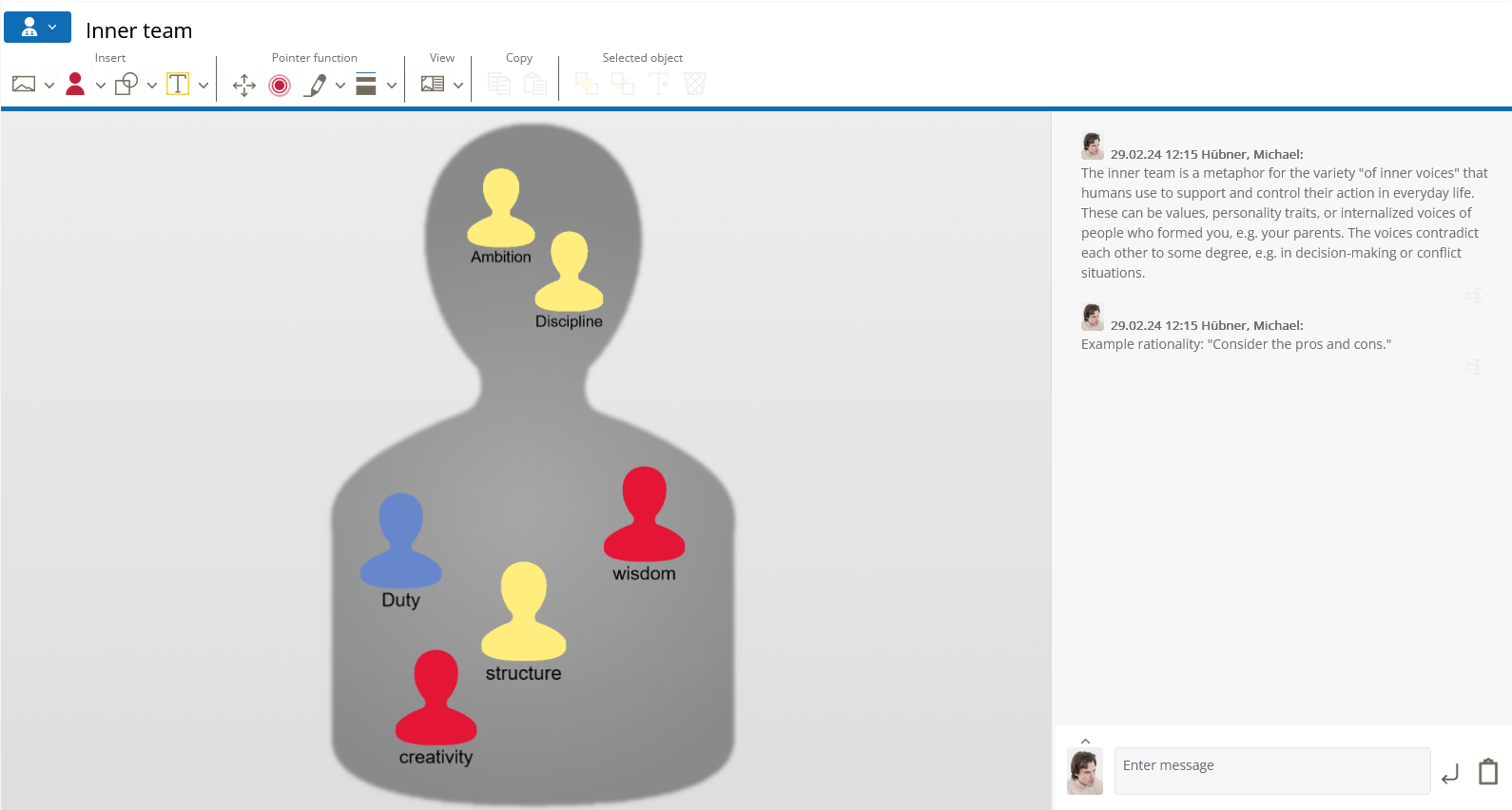
psychology Moderating Inner Voices Clients visualize their inner voices – such as values, personality parts, or internalized messages from significant figures (e.g., parents, managers, mentors). These voices are often in tension with each other, especially in challenging situations or during important decisions.
# Further Information
Related Topics
Basic operations (drawing, moving, deleting) are shared by all graphical tools. Details can be found here: General functions of graphical tools
# settings Operation and Design
Beyond the standard functions, the tool offers specific options to individually build the "inner stage":
# 1. Choosing the Right Stage (Background)
image
Select a background image that provides the framework for working with the inner parts. Options include:
- Abstract Silhouettes: To focus the attention directly on the person.
- Symbolic Settings: Use backgrounds such as a theater stage or an arena to represent the dynamics of the inner voices as an ensemble.
# 2. Adding Team Members
person sentiment_satisfied sentiment_neutral sentiment_dissatisfied sentiment_very_dissatisfied
To place a new inner team member on the workspace, you have two options:
- Neutral Cone Figures: Choose from various colors to represent parts in an objective and value-neutral way.
- Smiley Faces: Use symbols that can visualize a specific emotion or basic attitude.
Naming: Once you have selected a figure, a dialog opens. Enter the name for the team member (e.g., "The Inner Critic," "The Adventurous One," or "My Mentor"). This name can be changed at any time by double-clicking the label.
# 3. Capturing Messages and Quotes
sticky_note
To make the statements of individual team members tangible, you can use text cards. Ideally, choose the matching color of the figure to make the association immediately visible.
- Quotes of the Inner Voice: Note down concise sentences or beliefs typical for that specific part on the cards.
- Formatting as Speech Bubbles: For a particularly vivid representation on the "stage," the text object can be formatted as a cloud or ellipse. This creates the visual impression of a speech bubble, directly reflecting the dialogue within the Inner Team.
# tips_and_updates Why This Tool Works
By externalizing inner parts, clients step into an observer role (meta-perspective). This helps to:
- Resolve Ambivalences: When "two hearts beat in one chest," the conflict becomes graphically tangible.
- Regain Agency: As the "director" of their own team, clients can reset priorities and moderate compromises between the parts.
- Activate Resources: Often, "quiet" team members are discovered during this process, who can contribute valuable solutions.